Erin Yurday
Author
Author
15 September 2026
4 min read
Contents
Egg prices at UK supermarketsThe guidance on this site is based on our own analysis and is meant to help you identify options and narrow down your choices. We do not advise or tell you which product to buy; undertake your own due diligence before entering into any agreement.
Egg prices have risen faster than the wider food basket over the past few years, driven by bird flu, higher feed and energy costs, and disruption to global grain supply.
Prices checked 15 September 2026. Egg prices change frequently — the per-egg comparison below is more durable than the exact figures.
Supermarket | 6 medium free-range | Per egg | 12 medium free-range | Per egg |
Aldi | £1.49 | 24.8p | £2.49 | 20.8p |
Morrisons | £1.80 | 30.0p | £2.85 | 23.8p |
Tesco | £1.80 | 30.0p | £2.85 | 23.8p |
Asda | £1.80 | 30.0p | £2.85 | 23.8p |
Sainsbury's | £1.80 | 30.0p | £2.95 | 24.6p |
Three patterns stand out, and they tend to hold even as prices move.
The bigger box is cheaper per egg. At every retailer above, a 12-pack works out cheaper per egg than a six-pack — by around 16% at Aldi and 18% to 21% at the four large supermarkets.
The gap between retailers is smaller than it looks. Aldi's six-pack is about 21% cheaper per egg than the Big Four's, and its 12-pack around 13% cheaper. A meaningful difference, but not the sort of gap that would justify a separate trip.
Egg size and type make a bigger difference than the shop. Mixed-weight eggs cost considerably less per egg than standard medium free-range. Aldi sells a six-pack of mixed-weight free-range eggs for 99p, and Tesco a six-pack of mixed-weight barn eggs (268g) for £1 — both around 16.5p an egg. That's roughly a third less than Aldi's medium free-range, and over 40% less than the Big Four's. Note the two aren't equivalent: Aldi's are free-range and Tesco's are barn eggs, a different welfare standard.
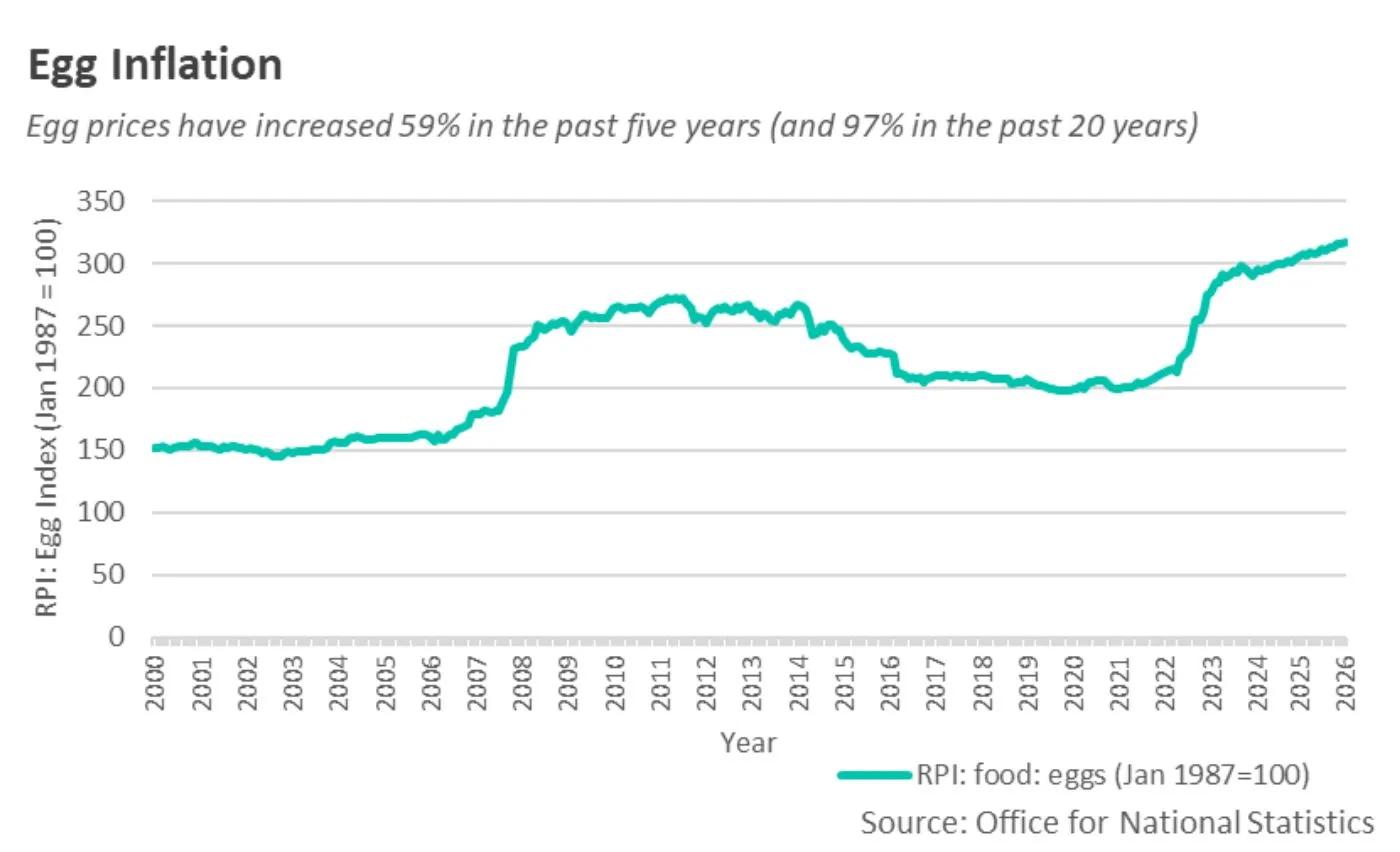
Over the five years from January 2021 to January 2026, average UK egg prices rose by around 59%.
A single product illustrates the scale. In February 2020, a box of six medium free-range eggs at Morrisons cost 75p. By March 2025 the same box was £1.65 — a 120% increase in five years. By February 2026 it had reached £1.75, and by September 2026, £1.80.
The chart above shows an index, where 100 represents the price in 1987. A rise from 200 to 300, as happened between 2020 and 2025, represents a 50% increase.
Feed costs. Ukraine is one of the world's largest grain producers, and the disruption to supply following Russia's invasion pushed up grain prices globally. That fed through to the cost of chicken feed, and on into the price at the till.
Energy and labour. Producers need electricity to light and heat sheds and to run refrigeration, and transport costs rose sharply alongside fuel prices. Those increases fed into the cost of getting eggs from farm to shelf.
Bird flu. A severe outbreak between 2022 and 2023 led to millions of birds being culled. Fewer hens meant fewer eggs, and at points supermarkets rationed how many boxes customers could buy.
Farmgate prices. Producers have long argued that supermarkets don't pay enough for their eggs. Some have left the sector or reduced flock sizes as a result, tightening supply further.
Changes to inheritance tax relief on agricultural property may also affect prices, as some farming families will face liabilities when passing farms on. The scale of that impact is disputed.
Consider mixed-weight eggs. These are the single biggest saving available — around a third to 40% less per egg than standard medium free-range, for eggs that vary in size rather than quality.
Check whether cheaper eggs are free-range or barn. Both appear at similar prices, but they're produced to different welfare standards.
Check the unit price on the shelf edge. The 12-pack is generally cheaper per egg, but the margin varies, and larger 15 or 18-egg boxes can be cheaper still.
Look at value ranges. Most supermarkets have a budget egg line, though these vary in whether they're free-range.
For more about grocery spending, read our article on average household food bills.
Author
15 September 2026
4 min read
Contents
Egg prices at UK supermarketsThe guidance on this site is based on our own analysis and is meant to help you identify options and narrow down your choices. We do not advise or tell you which product to buy; undertake your own due diligence before entering into any agreement.
Author
Erin was the founder of NimbleFins, a data driven personal finance site. A former derivatives trader and finance expert at the Stanford Graduate School, Erin turns research into plain answers so you can understand your credit.
Author
15 September 2026
4 min read
Contents
Egg prices at UK supermarketsThe guidance on this site is based on our own analysis and is meant to help you identify options and narrow down your choices. We do not advise or tell you which product to buy; undertake your own due diligence before entering into any agreement.
Egg prices have risen faster than the wider food basket over the past few years, driven by bird flu, higher feed and energy costs, and disruption to global grain supply.
Prices checked 15 September 2026. Egg prices change frequently — the per-egg comparison below is more durable than the exact figures.
Supermarket | 6 medium free-range | Per egg | 12 medium free-range | Per egg |
Aldi | £1.49 | 24.8p | £2.49 | 20.8p |
Morrisons | £1.80 | 30.0p | £2.85 | 23.8p |
Tesco | £1.80 | 30.0p | £2.85 | 23.8p |
Asda | £1.80 | 30.0p | £2.85 | 23.8p |
Sainsbury's | £1.80 | 30.0p | £2.95 | 24.6p |
Three patterns stand out, and they tend to hold even as prices move.
The bigger box is cheaper per egg. At every retailer above, a 12-pack works out cheaper per egg than a six-pack — by around 16% at Aldi and 18% to 21% at the four large supermarkets.
The gap between retailers is smaller than it looks. Aldi's six-pack is about 21% cheaper per egg than the Big Four's, and its 12-pack around 13% cheaper. A meaningful difference, but not the sort of gap that would justify a separate trip.
Egg size and type make a bigger difference than the shop. Mixed-weight eggs cost considerably less per egg than standard medium free-range. Aldi sells a six-pack of mixed-weight free-range eggs for 99p, and Tesco a six-pack of mixed-weight barn eggs (268g) for £1 — both around 16.5p an egg. That's roughly a third less than Aldi's medium free-range, and over 40% less than the Big Four's. Note the two aren't equivalent: Aldi's are free-range and Tesco's are barn eggs, a different welfare standard.
Over the five years from January 2021 to January 2026, average UK egg prices rose by around 59%.
A single product illustrates the scale. In February 2020, a box of six medium free-range eggs at Morrisons cost 75p. By March 2025 the same box was £1.65 — a 120% increase in five years. By February 2026 it had reached £1.75, and by September 2026, £1.80.
The chart above shows an index, where 100 represents the price in 1987. A rise from 200 to 300, as happened between 2020 and 2025, represents a 50% increase.
Feed costs. Ukraine is one of the world's largest grain producers, and the disruption to supply following Russia's invasion pushed up grain prices globally. That fed through to the cost of chicken feed, and on into the price at the till.
Energy and labour. Producers need electricity to light and heat sheds and to run refrigeration, and transport costs rose sharply alongside fuel prices. Those increases fed into the cost of getting eggs from farm to shelf.
Bird flu. A severe outbreak between 2022 and 2023 led to millions of birds being culled. Fewer hens meant fewer eggs, and at points supermarkets rationed how many boxes customers could buy.
Farmgate prices. Producers have long argued that supermarkets don't pay enough for their eggs. Some have left the sector or reduced flock sizes as a result, tightening supply further.
Changes to inheritance tax relief on agricultural property may also affect prices, as some farming families will face liabilities when passing farms on. The scale of that impact is disputed.
Consider mixed-weight eggs. These are the single biggest saving available — around a third to 40% less per egg than standard medium free-range, for eggs that vary in size rather than quality.
Check whether cheaper eggs are free-range or barn. Both appear at similar prices, but they're produced to different welfare standards.
Check the unit price on the shelf edge. The 12-pack is generally cheaper per egg, but the margin varies, and larger 15 or 18-egg boxes can be cheaper still.
Look at value ranges. Most supermarkets have a budget egg line, though these vary in whether they're free-range.
For more about grocery spending, read our article on average household food bills.
Author
15 September 2026
4 min read
Contents
Egg prices at UK supermarketsThe guidance on this site is based on our own analysis and is meant to help you identify options and narrow down your choices. We do not advise or tell you which product to buy; undertake your own due diligence before entering into any agreement.
Author
Erin was the founder of NimbleFins, a data driven personal finance site. A former derivatives trader and finance expert at the Stanford Graduate School, Erin turns research into plain answers so you can understand your credit.