Erin Yurday
Author
Author
10 September 2026
5 min read
Contents
How a Pawnshop Loan WorksAverage Cost of Pawnshop Loans in the UKWhat Happens if You Can't Repay?Pawnshop vs Credit CardPawnshop vs Payday LoanOther Alternatives to ConsiderHow to Find a PawnbrokerThe guidance on this site is based on our own analysis and is meant to help you identify options and narrow down your choices. We do not advise or tell you which product to buy; undertake your own due diligence before entering into any agreement.
Some people who need cash quickly consider going to a pawnbroker. A pawnbroker lends you money against your valuables, and returns the item when you repay the loan plus interest on time.
Pawnbroking is a form of high-cost credit. According to MoneyHelper, it's typically more expensive than a loan from a high street bank, though it would normally cost less than a short-term or payday loan. Whether that holds in any specific case depends on the rate offered, how long the loan runs, and whether it's repaid on time.
Three factors determine how well a pawnshop loan fits a given situation: whether losing the pawned item would matter, whether the debt can realistically be repaid within the agreement period (typically six to seven months), and whether cheaper borrowing options are available.
Disclaimer: Information in this article is based on publicly available information believed accurate at the time of publication and may change without notice. Please confirm current details with the relevant providers before deciding.
ClearScore is a credit broker, not a lender.
Dealing with a pawnbroker is usually straightforward. You bring your valuables to a pawnshop, where a broker values the item and offers a loan against it — typically up to around 60% of the item's second-hand value. You'll also need identification and proof of address, for instance:
Passport
National ID card
Driving licence
Utility bill
Bank statement
You'll complete a loan application and receive Pre-Contract Credit Information setting out the terms, including a 14-day cooling-off period. The pawnbroker will also give you a pawn receipt (unless it forms part of the credit agreement), which you'll need to prove the item is yours.
This is a loan, not a sale; the pawnbroker holds the valuables as collateral. Agreements typically run six to seven months, and you can repay early. A pawnbroker should let you collect your item at any point and charge interest only for the time you've actually borrowed the money, so repaying sooner reduces the interest owed.
Pawnshop loans typically cost between 5% and 10% per month. Pawnbrokers must show the annual interest rate and APR alongside any monthly or daily rate, so the full cost should be visible in the credit agreement before you sign.
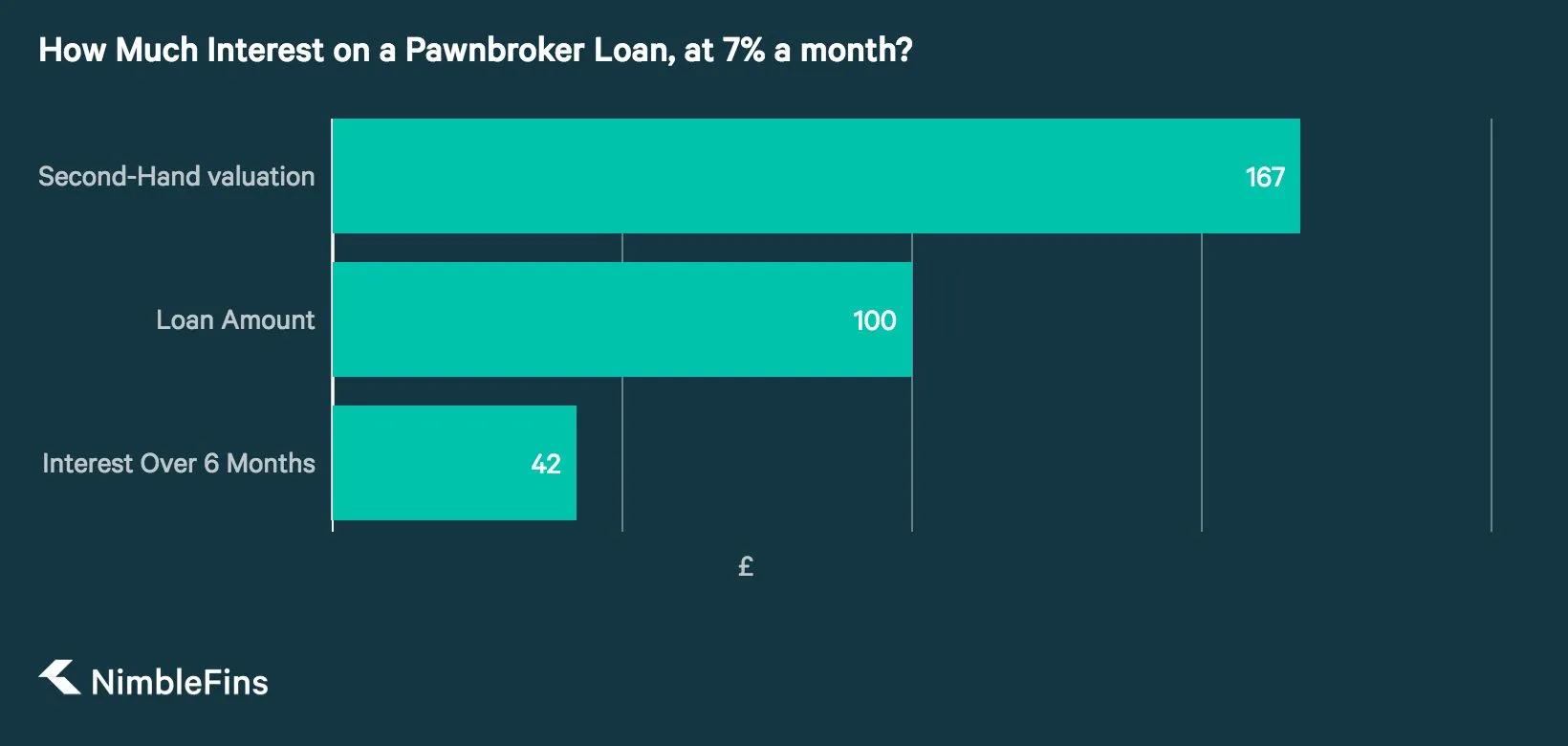
Consider a customer who pawns a gold ring — the most commonly pawned item. The pawnshop values the ring at £167 and offers a six-month loan of 60% of that value, or £100, at 7% per month.
At the end of six months, repaying £142 retrieves the ring. This is an illustrative example only. Actual rates and values vary by pawnbroker and item.
Interest on a 6-Month, £100 pawnshop loan at 7% a month | Type | Type |
Monthly Interest | £100 times 7% per month | £7 |
Total Interest | £7 times 6 months | £42 |
If you can't repay by the end of the agreement, you don't get your valuables back, and what happens next depends on the amount borrowed:
Up to £75: ownership passes automatically to the pawnbroker, who keeps all proceeds when the item is sold.
Over £75: the pawnbroker can sell the item. If it sells for more than you owe (including interest and any costs, such as auction fees), you should receive the difference.
Over £100: the pawnbroker must give you notice that the item is due to be sold, and allow you 14 days to repay before selling it.
If the item sells for less than you owe, a pawnbroker won't usually pursue you for the shortfall, though this isn't guaranteed and varies between pawnbrokers.
Credit cards are usually a cheaper way to borrow than a pawnshop loan. The average credit card APR was 24.66% as of January 2026 (the highest level in over 30 years) and 0% balance transfer and 0% purchase cards are available for those who qualify.
Those who only qualify for a credit-builder card would face higher rates: typically a representative APR between 29.9% and 39.9% as of September 2026, according to our analysis of credit cards for bad credit. Rates on cash transactions using these cards are typically higher still.
Where speed matters, a pawnshop loan provides funds faster than a new credit card application — cash can be in hand within hours. Pawnbrokers also don't carry out credit checks, since the loan is secured against the item rather than assessed on creditworthiness.
Since January 2015, the FCA has capped payday lending costs in three ways:
Interest and fees cannot exceed 0.8% per day of the amount borrowed
Fixed default fees are capped at £15
Total cost cap of 100% — a borrower never repays more than double the original amount in interest, fees and charges combined
Even within these limits, the cost can be substantial: under the cap, someone taking a 30-day loan and repaying on time can be charged up to £24 in fees and charges per £100 borrowed, according to the FCA, with a default fee of up to £15 on top if a payment is missed.
MoneyHelper lists several alternatives to high-cost credit that may be cheaper:
Credit unions — typically allow borrowing a small amount for a short period, at capped rates
Salary advance schemes — an employee benefit allowing access to some pay before payday, though payday itself is then reduced
Community Development Finance Institutions — lend to people who struggle to access credit, though rates are typically higher than credit unions
Bank overdrafts — provided you stay within the agreed limit and avoid default charges
Both large chains and independent pawnbrokers operate throughout the UK. Currently trading chains include H&T, Cash Converters and Ramsdens.
The National Pawnbrokers' Association (NPA) operates a code of conduct for its members, which provides an additional level of protection. If a local pawnbroker closes, the NPA may be able to help you reach them.
Complaints about a pawnbroker should be made in writing first. If that doesn't resolve the issue, they can be escalated to the Financial Ombudsman Service.
Author
10 September 2026
5 min read
Contents
How a Pawnshop Loan WorksAverage Cost of Pawnshop Loans in the UKWhat Happens if You Can't Repay?Pawnshop vs Credit CardPawnshop vs Payday LoanOther Alternatives to ConsiderHow to Find a PawnbrokerThe guidance on this site is based on our own analysis and is meant to help you identify options and narrow down your choices. We do not advise or tell you which product to buy; undertake your own due diligence before entering into any agreement.
Author
Erin was the founder of NimbleFins, a data driven personal finance site. A former derivatives trader and finance expert at the Stanford Graduate School, Erin turns research into plain answers so you can understand your credit.
Author
10 September 2026
5 min read
Contents
How a Pawnshop Loan WorksAverage Cost of Pawnshop Loans in the UKWhat Happens if You Can't Repay?Pawnshop vs Credit CardPawnshop vs Payday LoanOther Alternatives to ConsiderHow to Find a PawnbrokerThe guidance on this site is based on our own analysis and is meant to help you identify options and narrow down your choices. We do not advise or tell you which product to buy; undertake your own due diligence before entering into any agreement.
Some people who need cash quickly consider going to a pawnbroker. A pawnbroker lends you money against your valuables, and returns the item when you repay the loan plus interest on time.
Pawnbroking is a form of high-cost credit. According to MoneyHelper, it's typically more expensive than a loan from a high street bank, though it would normally cost less than a short-term or payday loan. Whether that holds in any specific case depends on the rate offered, how long the loan runs, and whether it's repaid on time.
Three factors determine how well a pawnshop loan fits a given situation: whether losing the pawned item would matter, whether the debt can realistically be repaid within the agreement period (typically six to seven months), and whether cheaper borrowing options are available.
Disclaimer: Information in this article is based on publicly available information believed accurate at the time of publication and may change without notice. Please confirm current details with the relevant providers before deciding.
ClearScore is a credit broker, not a lender.
Dealing with a pawnbroker is usually straightforward. You bring your valuables to a pawnshop, where a broker values the item and offers a loan against it — typically up to around 60% of the item's second-hand value. You'll also need identification and proof of address, for instance:
Passport
National ID card
Driving licence
Utility bill
Bank statement
You'll complete a loan application and receive Pre-Contract Credit Information setting out the terms, including a 14-day cooling-off period. The pawnbroker will also give you a pawn receipt (unless it forms part of the credit agreement), which you'll need to prove the item is yours.
This is a loan, not a sale; the pawnbroker holds the valuables as collateral. Agreements typically run six to seven months, and you can repay early. A pawnbroker should let you collect your item at any point and charge interest only for the time you've actually borrowed the money, so repaying sooner reduces the interest owed.
Pawnshop loans typically cost between 5% and 10% per month. Pawnbrokers must show the annual interest rate and APR alongside any monthly or daily rate, so the full cost should be visible in the credit agreement before you sign.
Consider a customer who pawns a gold ring — the most commonly pawned item. The pawnshop values the ring at £167 and offers a six-month loan of 60% of that value, or £100, at 7% per month.
At the end of six months, repaying £142 retrieves the ring. This is an illustrative example only. Actual rates and values vary by pawnbroker and item.
Interest on a 6-Month, £100 pawnshop loan at 7% a month | Type | Type |
Monthly Interest | £100 times 7% per month | £7 |
Total Interest | £7 times 6 months | £42 |
If you can't repay by the end of the agreement, you don't get your valuables back, and what happens next depends on the amount borrowed:
Up to £75: ownership passes automatically to the pawnbroker, who keeps all proceeds when the item is sold.
Over £75: the pawnbroker can sell the item. If it sells for more than you owe (including interest and any costs, such as auction fees), you should receive the difference.
Over £100: the pawnbroker must give you notice that the item is due to be sold, and allow you 14 days to repay before selling it.
If the item sells for less than you owe, a pawnbroker won't usually pursue you for the shortfall, though this isn't guaranteed and varies between pawnbrokers.
Credit cards are usually a cheaper way to borrow than a pawnshop loan. The average credit card APR was 24.66% as of January 2026 (the highest level in over 30 years) and 0% balance transfer and 0% purchase cards are available for those who qualify.
Those who only qualify for a credit-builder card would face higher rates: typically a representative APR between 29.9% and 39.9% as of September 2026, according to our analysis of credit cards for bad credit. Rates on cash transactions using these cards are typically higher still.
Where speed matters, a pawnshop loan provides funds faster than a new credit card application — cash can be in hand within hours. Pawnbrokers also don't carry out credit checks, since the loan is secured against the item rather than assessed on creditworthiness.
Since January 2015, the FCA has capped payday lending costs in three ways:
Interest and fees cannot exceed 0.8% per day of the amount borrowed
Fixed default fees are capped at £15
Total cost cap of 100% — a borrower never repays more than double the original amount in interest, fees and charges combined
Even within these limits, the cost can be substantial: under the cap, someone taking a 30-day loan and repaying on time can be charged up to £24 in fees and charges per £100 borrowed, according to the FCA, with a default fee of up to £15 on top if a payment is missed.
MoneyHelper lists several alternatives to high-cost credit that may be cheaper:
Credit unions — typically allow borrowing a small amount for a short period, at capped rates
Salary advance schemes — an employee benefit allowing access to some pay before payday, though payday itself is then reduced
Community Development Finance Institutions — lend to people who struggle to access credit, though rates are typically higher than credit unions
Bank overdrafts — provided you stay within the agreed limit and avoid default charges
Both large chains and independent pawnbrokers operate throughout the UK. Currently trading chains include H&T, Cash Converters and Ramsdens.
The National Pawnbrokers' Association (NPA) operates a code of conduct for its members, which provides an additional level of protection. If a local pawnbroker closes, the NPA may be able to help you reach them.
Complaints about a pawnbroker should be made in writing first. If that doesn't resolve the issue, they can be escalated to the Financial Ombudsman Service.
Author
10 September 2026
5 min read
Contents
How a Pawnshop Loan WorksAverage Cost of Pawnshop Loans in the UKWhat Happens if You Can't Repay?Pawnshop vs Credit CardPawnshop vs Payday LoanOther Alternatives to ConsiderHow to Find a PawnbrokerThe guidance on this site is based on our own analysis and is meant to help you identify options and narrow down your choices. We do not advise or tell you which product to buy; undertake your own due diligence before entering into any agreement.
Author
Erin was the founder of NimbleFins, a data driven personal finance site. A former derivatives trader and finance expert at the Stanford Graduate School, Erin turns research into plain answers so you can understand your credit.