Erin Yurday
Author
Author
10 September 2026
8 min read
Contents
How is the minimum monthly payment calculated? When does the floor kick in? Should you only pay the minimum each month? How to find the minimum payment floor Paying above the floor FAQsThe guidance on this site is based on our own analysis and is meant to help you identify options and narrow down your choices. We do not advise or tell you which product to buy; undertake your own due diligence before entering into any agreement.
CREDIT CARDS BY FEATURES
Best Credit Cards for Bad CreditBest Balance Transfer Credit CardsBest 0% Interest Credit Cards for PurchasesBest Travel Credit CardsBest Credit Cards with No Annual FeeBest Travel Credit CardsBest Credit Cards for StudentsBest Cashback Credit CardsBest Rewards Credit CardsBest Hotel Rewards Credit CardsHave you ever looked at how the minimum monthly payment on your credit card is calculated? Most people haven't — but it makes a substantial difference to how long a balance takes to clear and how much interest is paid along the way.
With the average quoted UK credit card interest rate (APR) at 24.71% as of August 2026 — the highest in over 30 years — the "minimum payment trap" isn't just a slow way to pay off debt. It can extend repayment across decades and add thousands of pounds in interest.
We may receive commission if you click through or take out a product.
Note on the examples below: these use an illustrative APR of 24.9%, a round figure close to the current quoted UK market average. Actual rates vary by card and by individual circumstances.
ClearScore is a credit broker, not a lender.
The minimum payment is determined by your interest rate, your outstanding balance, and any default charges.
Each credit card company sets its own rules, but a minimum monthly payment is typically calculated as the highest of:
£5 (or the full outstanding balance if it's less than £5) — this is called the "floor"
2.5% of the balance
1% of the balance plus interest and default charges
Rates on credit-builder cards sit well above the market average — typically a representative APR between 29.9% and 39.9%, according to our analysis of credit cards for bad credit. At higher rates, a larger share of the minimum payment goes to interest, leaving less to reduce the balance.
The minimum monthly payment "floor" is the amount below which your minimum payment will never fall. Most credit cards impose a floor of £5, though some providers set a higher floor of between £10 and £25.
A smaller floor might appear more manageable, but it works against the cardholder: the smaller the floor, the longer the debt takes to clear and the more interest accumulates. A higher floor clears debt sooner and costs less in interest overall.
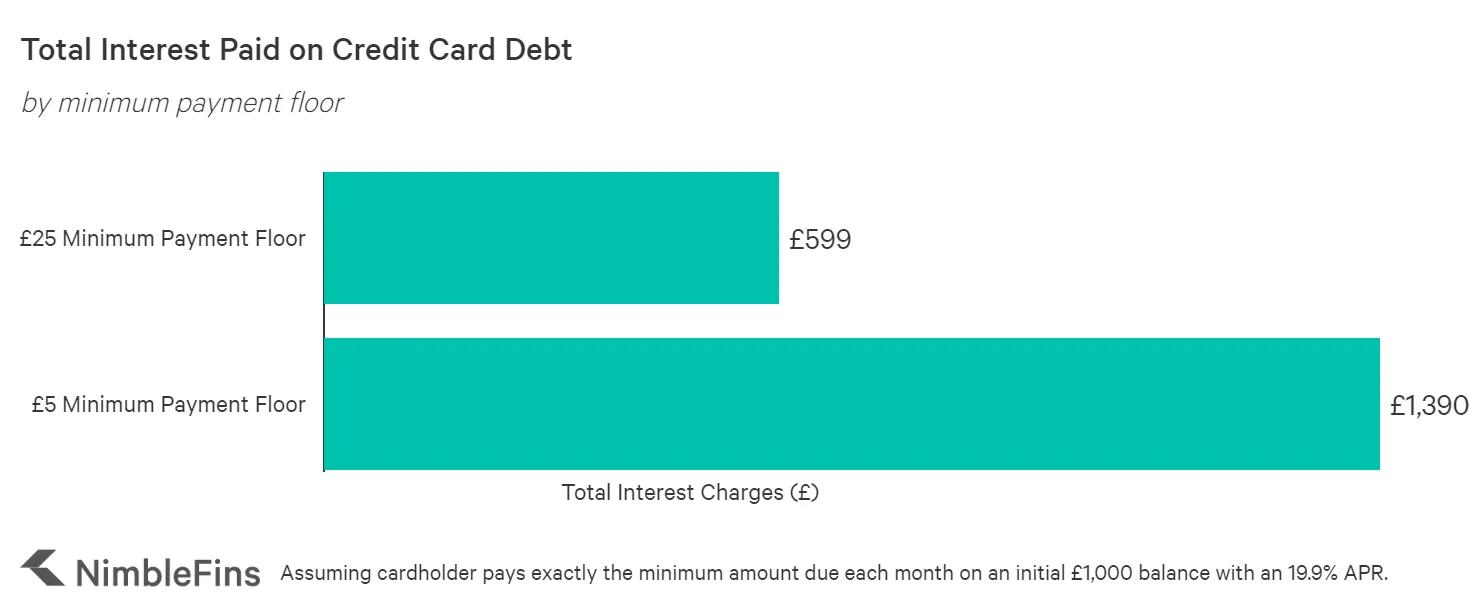
The chart below compares the approximate total interest paid on a £1,000 balance at 19.9% APR, where only the minimum payment is made each month, under a £5 floor and a £25 floor. At this rate, the higher floor saves around £790 in interest over the life of the debt. (The worked example further down uses a higher rate of 24.9%, closer to the current market average, where the saving rises to around £880.)
If nothing further is added to the balance, the minimum payment declines over time as the amount owed falls (because it's calculated partly as a percentage of the balance). This continues until the floor is reached.
For a credit card charging 24.9% APR, a £25 floor kicks in for balances below around £810 (where the minimum payment is calculated as interest plus 1% of the statement balance). From that point, the minimum payment stays at a fixed £25 as the balance is paid down to zero.
A card with a £5 floor takes much longer to clear, because the minimum payment keeps declining until the balance falls to around £160, at which point the £5 floor applies.
Floor | Floor kicks in for balances below… | Time to pay debt | Total interest charges |
£5 | £160 | 19 years 4 months | £1,813 |
£25 | £808 | 6 years 3 months | £934 |
Based on a £1,000 starting balance at 24.9% APR, paying only the minimum each month. Interest is calculated monthly at 1/12th of the APR on the opening balance; the minimum payment is the greater of the floor or interest plus 1% of the statement balance.
The crossover point moves with the interest rate. At a higher APR, more of each payment goes to interest, so the percentage-based portion drops below the floor at a lower balance.
Paying at least the minimum each month avoids default charges and a missed-payment marker on your credit file. Paying more than the minimum does two further things:
Reduces the total interest paid over the life of the debt
Reduces the time taken to become debt free
Credit cards are an expensive form of borrowing relative to most alternatives, so clearing balances sooner reduces the overall cost.
The minimum payment floor appears in a card's Summary Box, under "Minimum Payment." Searching the card's brand and product name plus "summary box" will usually locate it — most providers make these easy to find.
For anyone who expects to pay only the minimum in some months, the floor is a factor worth comparing between cards alongside the APR, since a higher floor reduces total interest over time.
The table below shows minimum payment floors for a range of UK credit cards. This alphabetical list is not exhaustive, is subject to change, and may vary between cards from the same provider — it's intended to illustrate the range of floors in the UK market.
Card provider | Minimum monthly payment floor |
American Express | £25 |
Aqua | £5 |
Barclaycard | £5 |
HSBC | £5 |
Lloyds | £5 |
Marbles | £5 |
Partnership Card | £5 |
Santander | £5 |
Tesco | £25 |
Vanquis | £10 |
Virgin Money | £25 |
The calculation alongside the floor also varies between cards. Most use a percentage of the balance plus interest and charges, but the percentage differs — Barclaycard uses 1% on most of its cards, while some providers use 2.5%. Some formulas include additional components: the Amex Platinum Cashback card, for instance, adds 1/12th of the annual fee to interest, default fees and 2% of the balance, with a £25 floor.
For more, see our Top Tips to Reduce Credit Card Interest Payments.
Where a balance is being carried, paying only the minimum extends the repayment period considerably — as the table above shows, potentially by more than a decade at a £5 floor. Paying even £10 or £20 above the floor each month meaningfully shortens that timeline and reduces the total interest paid.
Disclaimer: ClearScore is a credit broker, not a lender, and does not cover the whole of the market. The offers shown are drawn from ClearScore's panel of lenders and partners, so other products may be available elsewhere that are not featured here. ClearScore may receive a commission from the lender if you take out a product through the service. This does not affect the price you pay.
Paying less than the minimum typically triggers a default fee (usually around £12), and the missed payment may be reported to the credit reference agencies, affecting your credit score. The interest rate may also increase if the provider reassesses the account as higher risk.
Contacting the card provider is the first step — many can pause payments, particularly where the difficulty is temporary. Free debt advice is available from organisations including StepChange, National Debtline and Citizens Advice.
A minimum payment is relevant when an account has an outstanding balance; a zero balance does not create a payment due.
Yes. During the 0% period the minimum payment contains no interest charge, so the full amount goes towards reducing the balance.
The minimum payment due is the amount payable each month, typically covering a portion of the balance plus interest charges and any default fees.
The minimum payment on Amex credit cards is the higher of: £25 (or the total owed if less), or the total of any interest, default fees, repayment protection insurance and 1/12th of any annual fee, plus 2% of the amount owed.
The minimum payment on Tesco credit cards is typically the higher of: £25 plus arrears from the previous statement (or the full amount owed if less); any interest and default charges plus 1% of the balance plus arrears; or the amount owed over the credit limit including over-limit fees.
Typically the higher of: £10 (or the full amount owed if less), or any interest and default charges plus 1% of the balance, depending on the APR.
Typically the higher of: £5 (or the full amount owed if less), or any interest and default charges plus 1% of the total balance, plus any arrears.
Card details correct as of 10 September 2026. Terms, rates and features are subject to change — always verify current details before applying. This article is for general information only and does not constitute financial advice.
Author
10 September 2026
8 min read
Contents
How is the minimum monthly payment calculated? When does the floor kick in? Should you only pay the minimum each month? How to find the minimum payment floor Paying above the floor FAQsThe guidance on this site is based on our own analysis and is meant to help you identify options and narrow down your choices. We do not advise or tell you which product to buy; undertake your own due diligence before entering into any agreement.
CREDIT CARDS BY FEATURES
Best Credit Cards for Bad CreditBest Balance Transfer Credit CardsBest 0% Interest Credit Cards for PurchasesBest Travel Credit CardsBest Credit Cards with No Annual FeeBest Travel Credit CardsBest Credit Cards for StudentsBest Cashback Credit CardsBest Rewards Credit CardsBest Hotel Rewards Credit CardsAuthor
Erin was the founder of NimbleFins, a data driven personal finance site. A former derivatives trader and finance expert at the Stanford Graduate School. Erin turns research into plain answers so you can understand your credit.
Author
10 September 2026
8 min read
Contents
How is the minimum monthly payment calculated? When does the floor kick in? Should you only pay the minimum each month? How to find the minimum payment floor Paying above the floor FAQsThe guidance on this site is based on our own analysis and is meant to help you identify options and narrow down your choices. We do not advise or tell you which product to buy; undertake your own due diligence before entering into any agreement.
CREDIT CARDS BY FEATURES
Best Credit Cards for Bad CreditBest Balance Transfer Credit CardsBest 0% Interest Credit Cards for PurchasesBest Travel Credit CardsBest Credit Cards with No Annual FeeBest Travel Credit CardsBest Credit Cards for StudentsBest Cashback Credit CardsBest Rewards Credit CardsBest Hotel Rewards Credit CardsHave you ever looked at how the minimum monthly payment on your credit card is calculated? Most people haven't — but it makes a substantial difference to how long a balance takes to clear and how much interest is paid along the way.
With the average quoted UK credit card interest rate (APR) at 24.71% as of August 2026 — the highest in over 30 years — the "minimum payment trap" isn't just a slow way to pay off debt. It can extend repayment across decades and add thousands of pounds in interest.
We may receive commission if you click through or take out a product.
Note on the examples below: these use an illustrative APR of 24.9%, a round figure close to the current quoted UK market average. Actual rates vary by card and by individual circumstances.
ClearScore is a credit broker, not a lender.
The minimum payment is determined by your interest rate, your outstanding balance, and any default charges.
Each credit card company sets its own rules, but a minimum monthly payment is typically calculated as the highest of:
£5 (or the full outstanding balance if it's less than £5) — this is called the "floor"
2.5% of the balance
1% of the balance plus interest and default charges
Rates on credit-builder cards sit well above the market average — typically a representative APR between 29.9% and 39.9%, according to our analysis of credit cards for bad credit. At higher rates, a larger share of the minimum payment goes to interest, leaving less to reduce the balance.
The minimum monthly payment "floor" is the amount below which your minimum payment will never fall. Most credit cards impose a floor of £5, though some providers set a higher floor of between £10 and £25.
A smaller floor might appear more manageable, but it works against the cardholder: the smaller the floor, the longer the debt takes to clear and the more interest accumulates. A higher floor clears debt sooner and costs less in interest overall.
The chart below compares the approximate total interest paid on a £1,000 balance at 19.9% APR, where only the minimum payment is made each month, under a £5 floor and a £25 floor. At this rate, the higher floor saves around £790 in interest over the life of the debt. (The worked example further down uses a higher rate of 24.9%, closer to the current market average, where the saving rises to around £880.)
If nothing further is added to the balance, the minimum payment declines over time as the amount owed falls (because it's calculated partly as a percentage of the balance). This continues until the floor is reached.
For a credit card charging 24.9% APR, a £25 floor kicks in for balances below around £810 (where the minimum payment is calculated as interest plus 1% of the statement balance). From that point, the minimum payment stays at a fixed £25 as the balance is paid down to zero.
A card with a £5 floor takes much longer to clear, because the minimum payment keeps declining until the balance falls to around £160, at which point the £5 floor applies.
Floor | Floor kicks in for balances below… | Time to pay debt | Total interest charges |
£5 | £160 | 19 years 4 months | £1,813 |
£25 | £808 | 6 years 3 months | £934 |
Based on a £1,000 starting balance at 24.9% APR, paying only the minimum each month. Interest is calculated monthly at 1/12th of the APR on the opening balance; the minimum payment is the greater of the floor or interest plus 1% of the statement balance.
The crossover point moves with the interest rate. At a higher APR, more of each payment goes to interest, so the percentage-based portion drops below the floor at a lower balance.
Paying at least the minimum each month avoids default charges and a missed-payment marker on your credit file. Paying more than the minimum does two further things:
Reduces the total interest paid over the life of the debt
Reduces the time taken to become debt free
Credit cards are an expensive form of borrowing relative to most alternatives, so clearing balances sooner reduces the overall cost.
The minimum payment floor appears in a card's Summary Box, under "Minimum Payment." Searching the card's brand and product name plus "summary box" will usually locate it — most providers make these easy to find.
For anyone who expects to pay only the minimum in some months, the floor is a factor worth comparing between cards alongside the APR, since a higher floor reduces total interest over time.
The table below shows minimum payment floors for a range of UK credit cards. This alphabetical list is not exhaustive, is subject to change, and may vary between cards from the same provider — it's intended to illustrate the range of floors in the UK market.
Card provider | Minimum monthly payment floor |
American Express | £25 |
Aqua | £5 |
Barclaycard | £5 |
HSBC | £5 |
Lloyds | £5 |
Marbles | £5 |
Partnership Card | £5 |
Santander | £5 |
Tesco | £25 |
Vanquis | £10 |
Virgin Money | £25 |
The calculation alongside the floor also varies between cards. Most use a percentage of the balance plus interest and charges, but the percentage differs — Barclaycard uses 1% on most of its cards, while some providers use 2.5%. Some formulas include additional components: the Amex Platinum Cashback card, for instance, adds 1/12th of the annual fee to interest, default fees and 2% of the balance, with a £25 floor.
For more, see our Top Tips to Reduce Credit Card Interest Payments.
Where a balance is being carried, paying only the minimum extends the repayment period considerably — as the table above shows, potentially by more than a decade at a £5 floor. Paying even £10 or £20 above the floor each month meaningfully shortens that timeline and reduces the total interest paid.
Disclaimer: ClearScore is a credit broker, not a lender, and does not cover the whole of the market. The offers shown are drawn from ClearScore's panel of lenders and partners, so other products may be available elsewhere that are not featured here. ClearScore may receive a commission from the lender if you take out a product through the service. This does not affect the price you pay.
Paying less than the minimum typically triggers a default fee (usually around £12), and the missed payment may be reported to the credit reference agencies, affecting your credit score. The interest rate may also increase if the provider reassesses the account as higher risk.
Contacting the card provider is the first step — many can pause payments, particularly where the difficulty is temporary. Free debt advice is available from organisations including StepChange, National Debtline and Citizens Advice.
A minimum payment is relevant when an account has an outstanding balance; a zero balance does not create a payment due.
Yes. During the 0% period the minimum payment contains no interest charge, so the full amount goes towards reducing the balance.
The minimum payment due is the amount payable each month, typically covering a portion of the balance plus interest charges and any default fees.
The minimum payment on Amex credit cards is the higher of: £25 (or the total owed if less), or the total of any interest, default fees, repayment protection insurance and 1/12th of any annual fee, plus 2% of the amount owed.
The minimum payment on Tesco credit cards is typically the higher of: £25 plus arrears from the previous statement (or the full amount owed if less); any interest and default charges plus 1% of the balance plus arrears; or the amount owed over the credit limit including over-limit fees.
Typically the higher of: £10 (or the full amount owed if less), or any interest and default charges plus 1% of the balance, depending on the APR.
Typically the higher of: £5 (or the full amount owed if less), or any interest and default charges plus 1% of the total balance, plus any arrears.
Card details correct as of 10 September 2026. Terms, rates and features are subject to change — always verify current details before applying. This article is for general information only and does not constitute financial advice.
Author
10 September 2026
8 min read
Contents
How is the minimum monthly payment calculated? When does the floor kick in? Should you only pay the minimum each month? How to find the minimum payment floor Paying above the floor FAQsThe guidance on this site is based on our own analysis and is meant to help you identify options and narrow down your choices. We do not advise or tell you which product to buy; undertake your own due diligence before entering into any agreement.
CREDIT CARDS BY FEATURES
Best Credit Cards for Bad CreditBest Balance Transfer Credit CardsBest 0% Interest Credit Cards for PurchasesBest Travel Credit CardsBest Credit Cards with No Annual FeeBest Travel Credit CardsBest Credit Cards for StudentsBest Cashback Credit CardsBest Rewards Credit CardsBest Hotel Rewards Credit CardsAuthor
Erin was the founder of NimbleFins, a data driven personal finance site. A former derivatives trader and finance expert at the Stanford Graduate School. Erin turns research into plain answers so you can understand your credit.